Nobody Stole It: Why ₦40,000 Is Missing at the End of the Month
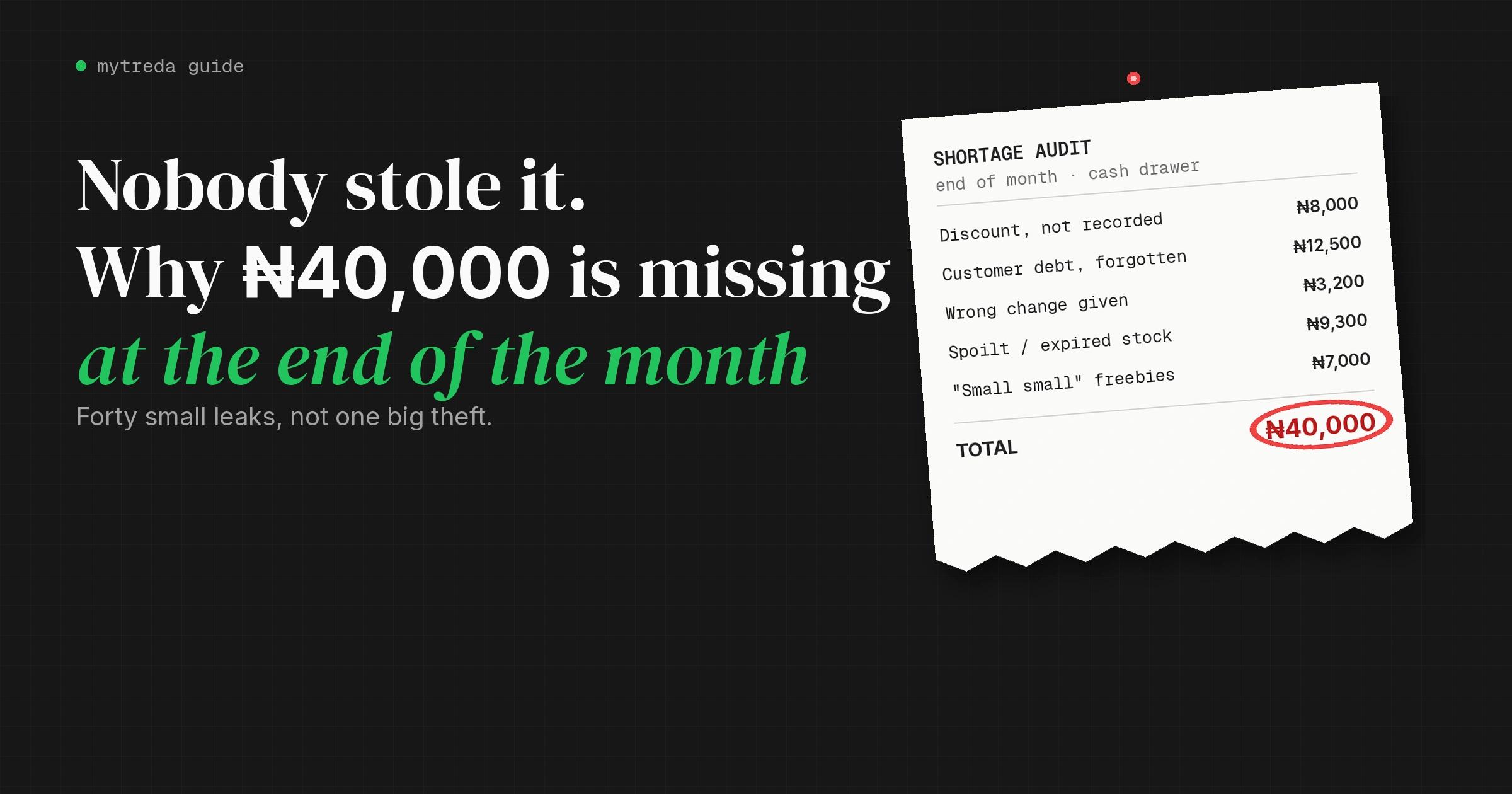
You know roughly what you sold. You know your prices. So where is the money? Most of the time it was not stolen. It left in forty small pieces, and every one of them made sense at the time.
There is a particular feeling at the end of a month that most traders know and few talk about.
The shop was busy. You barely sat down. You know roughly what went out and you know what your prices are, so you have a number in your head of what should be there. Then you count, and it is short. Not dramatically. Just ₦40,000 or so less than it should be.
And you cannot find it. Not because you are careless, but because there is nothing to find. There is no single missing ₦40,000. There are about forty missing ₦1,000s, spread across twenty-six trading days, and every one of them made complete sense at the moment it happened.
I have written before about how to tell when a sales boy is stealing from you. This post is about the other thing, the one that is far more common and gets almost no attention: money that leaves your shop without anybody stealing anything.
The Money Was Not Stolen. It Leaked.
Theft has a villain, so it gets all the attention. Leakage has no villain, which is exactly why it survives for years.
Here is what makes it so hard to see. Every single one of the leaks below is a reasonable decision made by a reasonable person, usually you. None of them feels like losing money at the time. Several of them feel like good business. They only become a problem in aggregate, and by the time they have aggregated, the trail is cold.
The Ways It Leaves
You gave change on a transfer you had not confirmed
The customer showed you the alert. You were busy, there were three people waiting, so you handed over the goods and the change.
Sometimes that transfer never lands. This is common enough that we wrote a whole guide on fake alerts and shop fraud, and the single rule that prevents most of it is that goods and change leave when the money is in your balance, not when a message is on your phone.
You cut the price to close the sale
The customer pushed. It was the end of the day. You took ₦4,200 instead of ₦4,500 because a sale is better than no sale, and that is often true.
Do it ten times in a month and it is ₦3,000, from a decision you have already forgotten making. The problem is not that you discounted; it is that the discount never got recorded, so the money looks like it went missing when actually you gave it away on purpose.
Somebody took goods and said they would pay
Your cousin. A regular who forgot their wallet. A neighbour who always pays. You did not write it down because writing it down felt like an insult, and because you would obviously remember.
You did not remember. Or you remembered the goods but not the amount, which is worse, because now you cannot ask without looking uncertain.
You paid for something out of the till
Transport for a delivery. A dispatch rider. Your apprentice's lunch. Fuel for the generator. Something small for the house because you were passing.
Each one is legitimate. But money that leaves the drawer without a note against it does not look like an expense at the end of the month. It looks like a shortage.
You put your own money in and forgot
The reverse also happens, and it hides the problem rather than causing it. You topped up the float from your pocket to make change for a big note, and never took it back. Now your cash looks healthier than your business actually is.
Stock got damaged, expired, or quietly walked
Water got into a carton. Items passed their date. A few things broke. Nobody hid anything, but nobody wrote it down either, so your records still say you have goods that you do not have. The gap shows up as money missing, because you counted that stock as future cash.
Goods left as a gift
Family, a friend of the family, a customer you wanted to keep sweet. Sometimes it is worth it. But if it is not recorded, it is not a business decision you made, it is a hole you cannot explain.
The change and float got muddled
Two people served customers from the same drawer. Somebody made change from their own pocket during a rush and took it back later, roughly. Somebody was ₦500 short and made it up. None of it was recorded because all of it was temporary.
Why You Cannot Find It in December
Look at that list and notice what it has in common. Every one of them is fixable in the moment and impossible to fix later.
If you know at 6pm on Tuesday that you are ₦2,000 short, you can actually answer it. You were there. Your staff were there. Somebody remembers the man who bought the generator and paid partly in cash. It is a two-minute conversation.
If you discover at the end of March that you are ₦40,000 short across the quarter, there is nothing to ask. Nobody remembers a Tuesday in February. You will either accept the loss or start suspecting people, and suspecting people with no evidence damages a shop more than ₦40,000 ever will.
That is the real cost of finding out late. Not the money. The fact that the only two options left are both bad.
The Habit That Fixes Most of It
Count your cash at the end of every trading day and compare it against what your records say should be there.
That is it. Not a system, not software, not a new set of books. One count, at the same time each day, before you leave.
The arithmetic is simple:
What you started with, plus your cash sales, minus any cash you paid out, is what should be in the drawer.
Count what is actually there. If the two numbers match, close up and go home. If they do not, you now have a small, fresh, answerable question instead of a large, old, unanswerable one.
One tip that matters more than it sounds: count the cash before you look at what it should be. If you know the target first, you will count towards it without meaning to. Everybody does. Count first, then compare.
What a Difference Actually Means
This is where traders get it wrong in both directions, so let me be clear.
A small difference now and then is normal. Change gets rounded, notes get miscounted, somebody paid ₦4,000 for something priced at ₦3,950 and told you not to bother. If you are short ₦200 on a Thursday, write the reason if you know it and move on. Treating that as a crisis will teach everyone who works for you to hide small problems, which is how you end up with big ones.
A pattern is a different thing entirely. Short on the same day of the week. Short only on the shifts one person works. Short always in the same rough amount. A difference that appears every single day, even a small one. Those are signals, and you can only see them if you have been writing the daily figure down, because a pattern is invisible one day at a time.
And when you do see a pattern, start with the process rather than the person. Most patterns turn out to be a habit nobody thought to mention: somebody who always pays the dispatch rider from the drawer, or a regular customer who has been taking goods on credit with the family's blessing for two years.
What to Do This Week
Tonight: Count what is in your drawer and write the figure down with the date. That is your starting point. It does not matter that it is not "correct" yet.
Every day this week: Write down what you started with, what you sold for cash, and anything you paid out of the drawer. Count at close. Note the difference, even when it is zero. Especially when it is zero.
When money leaves the drawer for any reason: write what it was for, in the moment. Transport, lunch, fuel, a gift, a discount you agreed. One line. This single habit closes more of the gap than everything else put together.
On Sunday: Look at your seven differences together. You will already see something you could not see on Monday.
How MyTreda Handles This
You can do all of this with a notebook and real discipline, and some traders genuinely do.
MyTreda does it as part of the day. You open your till with whatever cash you are starting with. Every sale you record adds to the expected figure, and when you take money out for transport or fuel or anything else, you record it as it happens, so it counts as an expense rather than disappearing.
At closing you enter what you actually counted. Only then does the app show you what it should have been, and the difference between them. That order is deliberate, for the reason above: if we showed you the expected figure first, your counting would drift towards it. You are also asked to note why, when there is a difference, so next month the answer is written down rather than remembered.
Where there is more than one person serving, each has their own till and their own closing figure, so a difference belongs to a shift instead of hanging over everybody. And because every sale carries its payment method, cash, transfer and card do not get tangled together when you are trying to work out what should be in the drawer.
It works offline, so closing your till does not depend on the network being up at 7pm. Plans start at ₦2,500/month.
Small Money Is Still Your Money
Nobody loses ₦40,000 in one afternoon and fails to notice. That is the entire problem. Losses that size are visible, so they get dealt with.
The money that actually goes missing from Nigerian shops goes in ₦500 and ₦2,000 pieces, on ordinary days, for ordinary reasons, and it never gets dealt with because it never announces itself.
Five minutes at the end of the day is what stands between a question you can answer and a mystery you cannot. That is a good trade.
Ready to try MyTreda?
Join thousands of Nigerian traders managing their business better with MyTreda.
Get Started TodayShare this article: