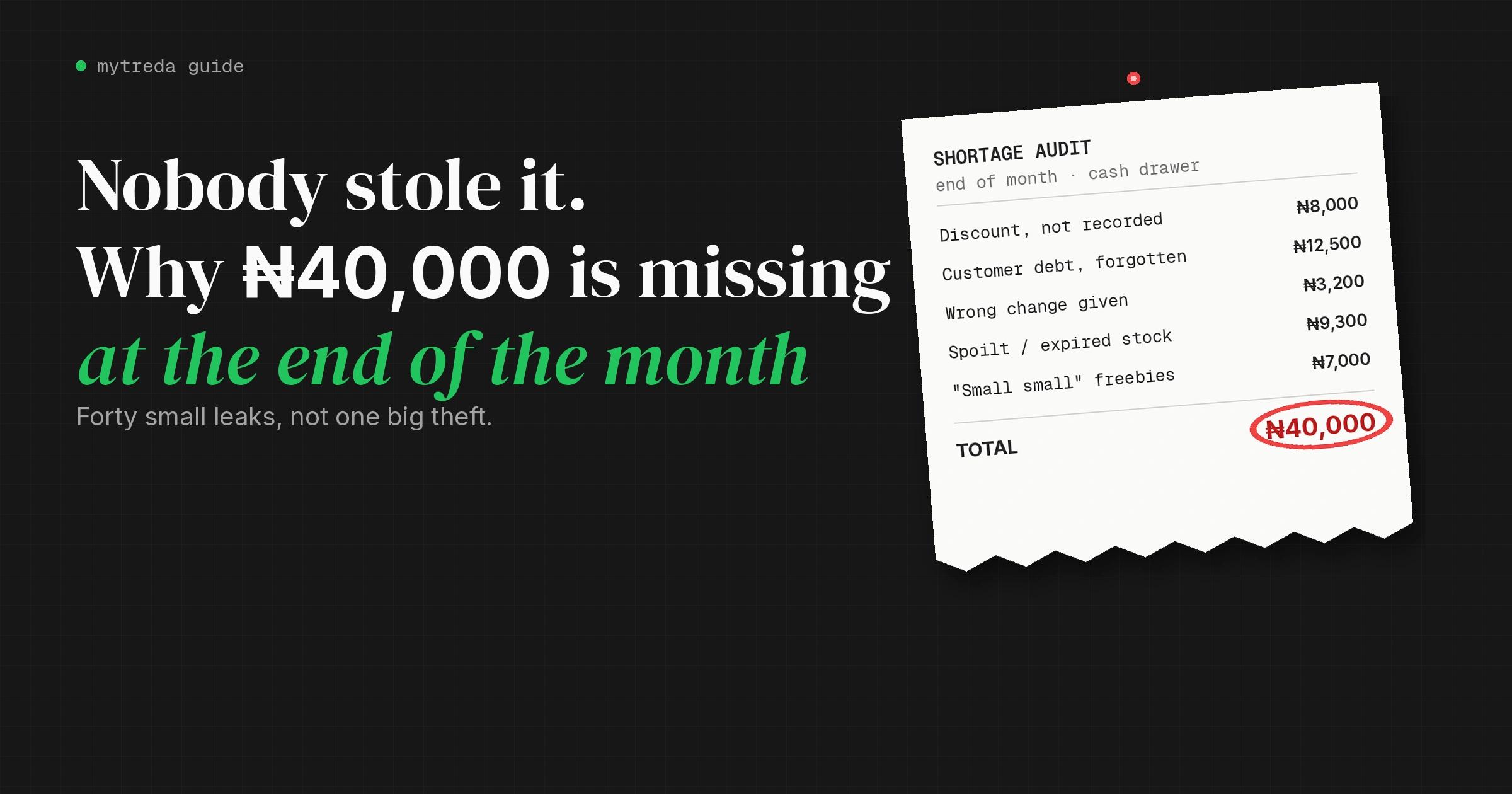
Nobody Ever Told You How to Pay Yourself
You have run your shop for years. If someone asked what you earn from it, could you answer? Most traders cannot, and it is not because they are doing badly. It is because of how the money is arranged.
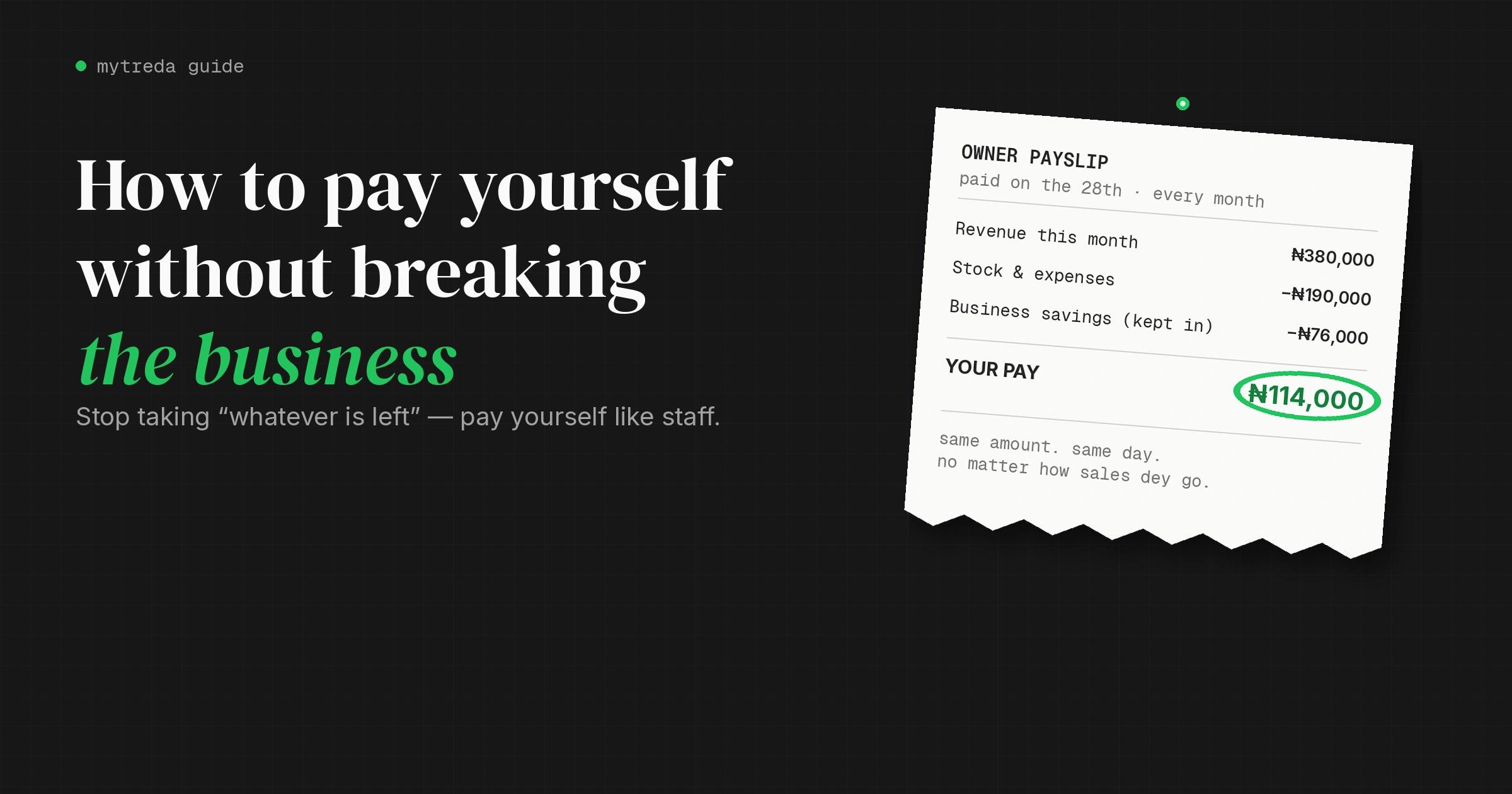
Ask a trader who has run a shop for eight years what they earn from it, and watch what happens.
They will tell you what the shop turns over. They will tell you what a good week looks like. What they usually cannot tell you is what they personally earn, because there is no number. Money comes into the shop. Money leaves the shop, some of it as stock, some of it as rent, and some of it as their life. The three are mixed and nobody separated them.
This is not carelessness. Almost every trader I know operates this way, including people whose businesses are doing genuinely well. It is simply the arrangement everybody inherits, and nobody ever sat you down and explained the alternative.
You will hear the advice often enough: keep business money separate from personal money. It is correct. It is also, as usually stated, close to useless, because whoever said it has never had to explain why they cannot help with a burial.
So let me take the difficulty seriously first.
Why This Is Genuinely Hard
There is no employer and no payday. A salaried person receives a fixed amount on a fixed date from somebody else. Nobody pays you. The money is simply there, in the drawer, and you are the person with the key. Waiting for a payday that nobody is going to declare makes no sense.
Your shop is the household. For most traders the business is not one source of income among several. It is the income. School fees, food, transport, rent, medicine, all of it comes from the same drawer that pays your supplier. Telling someone in that position to separate business from personal sounds like telling them to separate their left hand from their right.
Need does not arrive on schedule. A hospital bill does not wait for month end. A burial in the village comes with obligations that are not optional and not small. A brother's school fees fall due in a week when takings were poor. These are not indulgences. In our culture they are the things you would be ashamed not to do.
And taking from the till is the only mechanism you have. It is not indiscipline. It is the only route that exists when no other one was ever set up.
All of that is true. Here is what is also true.
What It Costs You Anyway
The arrangement is understandable. It is still expensive, and this is the part that rarely gets said plainly.
You cannot tell your wages from your profit. If your shop takes ₦300,000 clear in a month and you took ₦280,000 out of the drawer across those weeks, your business did not make ₦300,000. It made ₦20,000, and it paid you ₦280,000. Those are completely different businesses, and you cannot tell which one you own.
You cannot tell whether it is growing or being eaten. A shop that quietly funds a household can look busy and stable for years while never getting any bigger. From inside, the days feel the same. The stock is the same size it was in 2023. Nobody can point at the moment it stopped growing, because there was no moment.
You cannot plan a large purchase. October buying decides your December, and it needs a figure you are willing to commit. If your working capital and your household money are the same pile, you cannot commit anything with confidence, because you do not know what is genuinely spare.
Your prices are built on a fiction. If you never count your own labour as a cost, your margin looks better than it is. A line that seems to make money might only be making money because the person running the shop is unpaid. Work the margin out properly and some of what you sell will look different.
And the version that hurts most: you work for ten years, the shop feeds everybody, and at the end of it the business is the same size it was at the start. You cannot explain where it all went, because it did not go anywhere dramatic. It went home, ₦20,000 at a time, and nobody wrote it down.
The Fix Is Boring
There is no clever structure here. Four steps, none of them difficult.
1. Find out what you already pay yourself
Do not start by choosing a number. Start by finding the one you have been using without knowing it.
Look back at the last three months and add up everything you took out of the business for yourself and your household. All of it. The ₦5,000 you took on Tuesday, the money for fuel, the school fees, the transfer to your mother. Divide by three.
That figure is your salary. You have been paying it for years. You just never named it, which is exactly why you could never manage it.
Most traders are startled by this number. Some find it is far higher than they would have guessed. Others find it is embarrassingly low for the hours they work, which is its own useful piece of information.
2. Pick an amount and a day
Take the figure you found and set it as what you pay yourself, adjusting if you already know it is too high for the business to bear.
Then pick the day. Monthly works if your income is steady. For most traders weekly fits better, because it matches how money actually moves through a shop and it is easier to hold to. Same day every week. Not "when I need it."
3. Take it in one movement, and record it
On the day, take the whole amount at once. Not in pieces through the week.
Record it as a business expense, in the same place your rent and your staff wages go. Your own pay is a cost of running the shop exactly like theirs is. If you are using MyTreda, that is the Salaries category, and your name belongs in it next to everyone else's.
4. Then leave the drawer alone
This is the only hard step, and it is the one that does the work. Between paydays, the money in the drawer is not yours. It belongs to the business, the same way your employee's wages are not theirs to take early.
You will break this rule. Everybody does at first. The measure of success is not never breaking it, it is that when you break it you record it, so that it stays visible instead of disappearing.
When the Amount Is Not Enough
It will happen, and the answer matters.
If the business genuinely cannot pay you what you need to live, that is not a failure of the method. That is the method telling you something true that the old arrangement was hiding. There are only three explanations, and each has a different response:
- This month was slow. Normal in trade. This is what a small personal buffer is for, built in good months precisely so that bad months do not force you back into the drawer.
- The amount is too high for the business as it stands. Then you either reduce it for now or grow the business deliberately, and you now know which one you are choosing.
- The business cannot support you at this size. This is the hard one. It is also the most valuable thing the exercise can tell you, and finding out in year two is enormously better than finding out in year ten.
Before, none of those three were distinguishable. The shop simply absorbed the shortfall silently and you carried on.
When Family Need Arrives Mid-Month
It will. Pretending otherwise is how these systems collapse in the first month.
I am not going to tell you not to help. Often you should, and often you will regardless of what any article says. The point is not to refuse. The point is to make the money visible.
Two ways to handle it. Either it comes out of your own pay and your buffer, which is what the buffer exists for. Or, if it genuinely has to come from the business, you take it as a recorded withdrawal, with the date, the amount and what it was for.
That single line changes everything about it. ₦50,000 given to a brother and written down is a decision you made, and in December you can look at it and decide whether it was one you would make again. The same ₦50,000 not written down is part of the money you cannot account for at the end of the month, and it will make you suspect your staff of something they did not do.
Record it and you keep both things: your obligation to your family, and an honest view of your business. You do not have to choose between them. You only have to write it down.
What to Do This Week
Today: Add up what you actually took out over the last three months. Do not estimate it. Look.
This week: Decide the amount and the day. Tell somebody, your spouse or a business partner, so it is a commitment rather than an intention.
On your first payday: Take it in one movement. Record it as an expense under Salaries, with your name on it.
For the rest of the month: Every time you take money out outside of that, write it down. Not as a punishment. So you can see it.
In three months: Look back. You will be able to answer, for the first time, what you earn and what your business earns. Those two numbers are the beginning of every real decision you will make afterwards.
How MyTreda Handles This
Your own pay is recorded the same way as any other business expense, under Salaries, with the amount and the date. That means it shows up in your expense reports and comes out of your profit properly, rather than sitting in the gap between what the shop sold and what is actually in the drawer.
When you take cash out of the till during the day, that is recorded as money out with a reason attached, so at closing your expected cash reflects it instead of appearing as a shortage you have to explain to yourself.
The result is the one thing this whole post is about: your reports show what the business earned after paying you, not what it earned while quietly funding you. That is the number that tells you whether you are growing.
It works offline, and plans start at ₦2,500/month.
Pay the Person Doing the Work
You would not ask a member of staff to work all month and take whatever is left in the drawer at odd moments. You would consider it disrespectful, and you would expect them to leave.
You are doing the hardest job in your business. You open first and close last. You carry the risk that nobody else carries.
Put yourself on the payroll. Not because a finance book says so, but because until you do, you cannot tell whether the work you are doing every day is actually paying you, or whether you have simply been busy.
Busy and profitable feel identical from behind the counter. Only the records can tell you which one you have.
Ready to try MyTreda?
Join thousands of Nigerian traders managing their business better with MyTreda.
Get Started TodayShare this article: