You Lock Your Shop Every Night. Is Your Phone Locked?
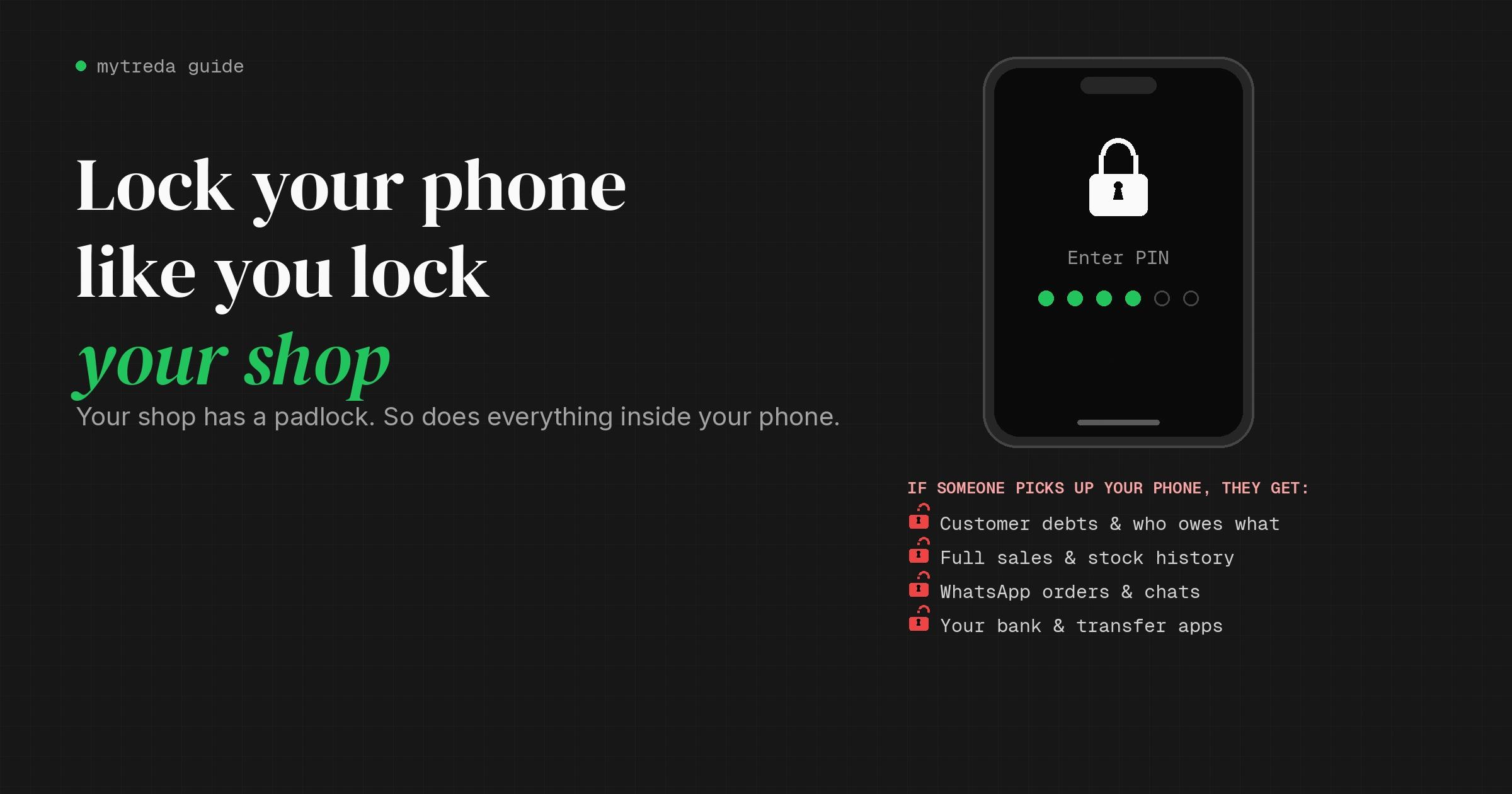
Your shop has a padlock, burglary proof and maybe a night guard, and it holds stock. Your phone holds your customers, your money and your records, and most traders leave it wide open.
Think about what you do at the end of a trading day.
You clear the front. You pull the shutter. You fix the padlock, and probably a second one. You paid for burglary proof on the windows. Some of you pay somebody to watch the place overnight. All of that protects a room containing stock.
Now think about the phone in your pocket.
On it: every customer you have ever chatted with, and their numbers. Your suppliers. Photos of goods, prices you quoted, promises you made. Your bank app. Whatever records you keep. For a lot of traders, that phone is more of the business than the shop is, and it is protected by a four-digit code that three people know, or by nothing at all.
I am not going to give you a list about strong passwords. Let me tell you what actually happens to Nigerian traders, and what to do about each one.
The Ways You Lose It
Somebody takes over your WhatsApp
This is the big one, and it deserves more space than the rest.
A message comes from a number you know, or from someone claiming to be from a group you belong to. The story is always some version of the same thing: a code was sent to your number by mistake, please send it back. Sometimes it is dressed up as a delivery confirmation, a church group, a market association, a job.
That code is what signs your WhatsApp in on somebody else's phone. Send it, and you are out and they are in.
The tell: anybody asking you for a code that arrived on your phone. There is no legitimate version of this. Not from a friend, not from a network, not from WhatsApp, not from your bank. A code sent to you is for you to enter, never to forward.
What happens next is the real damage. They are not after your chats. They now have a trusted identity: every one of your customers sees your name and your photo. They will message people asking for urgent money. Worse for a trader, they can sell in your name, collect payment into their own account, and the customer has no reason to doubt it until they come to your shop for goods you never sold.
The trust you built over years is the asset being stolen, and you cannot padlock it.
What to do: turn on WhatsApp's two-step verification PIN today. It is in WhatsApp's own settings, it takes a minute, and it means a code alone is not enough to sign in as you. It is the single highest-value thing in this entire post.
Your number gets reissued to somebody else
Someone walks into a shop with a story and enough of your details, and your line is reissued to their SIM. Your phone goes dead. Their phone starts receiving everything sent to your number.
That is how your WhatsApp goes, and it is also how the reset codes for your bank and your email go.
The tell: your phone loses service and stays dead while other phones nearby are fine. Not a network outage, not your bill. Just yours, not coming back.
What to do: treat it as an emergency the same hour, not tomorrow. Get to your network provider and get the line locked and restored. While that is happening, use another phone to sign out of what you can and to tell people not to trust messages from your number.
The phone was stolen and it was already signed in
Handset stolen at a bus stop, or left in a keke. The value of the phone is the smallest part of what you lost.
If it was open, or the code was 1234, or the code is one your apprentice watched you type, then whoever has it has your WhatsApp, your bank app and whatever else stays signed in.
What to do, before it happens: a real screen lock. Six digits at minimum, not your birth year, not the one your staff have seen you enter fifty times. Use the fingerprint if the phone has one. And know how to wipe it remotely — set that up on a quiet afternoon, not on the day.
Everybody in the shop uses one login
This one does not feel like security at all, which is why it lasts for years. One account, one password, everybody uses it. It is simply easier.
Three things follow. Nothing that happens can be traced to a person, so when something is wrong you are guessing. Any one of them can hand that password to somebody else, deliberately or by being careless. And the person who left in March still has it, because a shared password does not leave when a person does.
What to do: one account per person, and close theirs the day they stop working for you. Not the week after. The day.
The message that says your account will be blocked
A text or WhatsApp that looks like it is from your bank. Your account will be restricted, your BVN needs updating, click here to confirm. The link opens something that looks exactly like your bank's page and asks you to sign in.
The tell: the pressure. Real banks do not give you two hours to save your account. And any link that arrives with a warning attached deserves to be ignored on principle.
What to do: never reach your bank through a link somebody sent you. Open the app yourself, or dial the number printed on your card. If there is a genuine problem it will still be there when you arrive by your own route.
This is a cousin of the fake alert, run against your account instead of your till. Our fake alert and shop fraud guide covers the money side of the same craft.
If Your WhatsApp Is Already Gone
Move immediately. Every hour it is theirs, more of your customers get messaged.
Sign back in on your own phone. Registering your number again signs it out wherever else it is running. If the person set a PIN on the account, you may have to wait before you can complete this. WhatsApp's own help pages carry the current steps, and they change, so read theirs rather than anybody's blog, including this one.
Tell your customers by another route, now. Call the ones who matter most. Post on your other channels. Get somebody in your market association group to pass the word. A customer who hears from you first cannot be caught.
Warn people in the specific way that helps: say plainly that you are not asking anyone for money and that no account details coming from your number today are yours.
Then close the door behind you. Set the two-step PIN as soon as you are back in, so the same person cannot simply repeat it next week.
Three Things, This Week
Not a programme. Three things, none of which take an afternoon.
One: put a real lock on your phone. Six digits or a fingerprint, and not a code your staff have watched you type.
Two: turn on WhatsApp's two-step verification PIN. If you do nothing else on this page, do this one. It is the difference between one careless moment and losing every customer relationship you have.
Three: stop sharing one login. Give each person their own, and close accounts the day people leave.
That is it. Everything else on this page is understanding. Those three are the actions.
How MyTreda Handles This
Let me be exact about which doors we are and are not.
MyTreda cannot protect your WhatsApp, your bank app or your phone. Those are different doors with different keys, and the advice above is the whole of what we can offer on them.
What we do handle is your business records. Every person who works for you gets their own account rather than sharing yours, so what happens in the app belongs to a name. When somebody leaves, you deactivate them and they are out immediately, while everything they recorded stays exactly where it is — we never delete a person's history, because your sales and your activity log depend on it.
The activity log is the other half. It keeps what changed and who changed it, so a question about last Tuesday has an answer that does not depend on anybody's memory or anybody's honesty.
And there is one thing worth saying plainly about the stolen phone: if your records live only in a book in the shop or a note on that phone, they are gone with it. MyTreda keeps them in the cloud and syncs automatically, so a lost phone costs you a phone. You sign in on another one and your business is still there.
It works offline in between, and plans start at ₦2,500/month.
Protect the Thing That Is Actually Worth Something
Nobody needs convincing to lock a shop. We can see the shop. It cost money, the stock is stacked where we can count it, and a broken padlock is obvious in the morning.
The phone does not work like that. Nothing looks different after somebody takes over your WhatsApp. There is no broken lock to find, no gap on a shelf. You only learn about it when a customer arrives asking why you have not delivered goods they already paid for.
Your stock can be replaced. Twelve years of customers trusting your name cannot.
Lock the phone.
Ready to try MyTreda?
Join thousands of Nigerian traders managing their business better with MyTreda.
Get Started TodayShare this article: