Before You Borrow for Your Shop, Ask Your Sales Book First
A loan is paid from profit, not sales. How to work out what your shop can really repay, test it against a bad month, and avoid putting borrowed money into stock that sells slowly.

It's November. Your shop had a good year, customers are already asking about Christmas, and your supplier says prices will go up in December. A loan to stock up now looks like the smartest money you'll ever borrow.
Then December sales come in slower than you planned. Half the new stock is still on the shelf in January. And the lender does not care about your shelf. Repayment day arrives on the date it was always going to arrive.
That is how a good year turns into a hard one, and it rarely starts with a bad decision. It starts with a sum nobody did.
BIG SAM wrote a useful thread on X about risk in small businesses, and one line in it stayed with me: borrowing becomes dangerous when your repayment plan depends on everything going perfectly. His example was a processing machine. For most traders, the loan isn't for a machine. It's for stock. So this post is about that: how to tell, from your own sales, whether your shop can carry a loan before you take one.
You May Already Be Borrowing
Before you think about a new loan, count the ones you already have. Many traders say "I don't owe anybody" and then list three debts once they start writing.
- Goods on credit from your supplier. "Carry it, pay me next week" is a loan. It has no paperwork, but it has a due date, and the cost of missing it is your supplier's trust. Some suppliers also charge more for goods on credit than for cash, so ask for both prices.
- Ajo, esusu or thrift. If you collected your turn early, you owe every contribution still to come, whether this month is good or not.
- Cooperative loans. Usually friendlier than a bank, but the repayments come out of the same shop money.
- Loan apps. Quick to get, and quick to turn expensive when you're late.
- Bank or microfinance loans. Fixed repayments on fixed dates.
- Family and friends. No interest, often no date, and the most awkward one to be late on.
Every one of these is paid from the same place: what your shop makes. So the first step is to add them up. A new loan doesn't start from zero. It sits on top of these.
A Loan Is Paid From Profit, Not Sales
This is the mistake behind most borrowing trouble. A trader looks at sales, sees a big number, and decides a monthly repayment is small next to it.
But sales are not yours to spend. Most of every sale goes straight back into paying for the goods you sold. What's left has to cover rent, transport and staff before it covers you. The repayment comes out of whatever remains after all of that.
Say your shop sells ₦1,200,000 a month, and a ₦100,000 monthly repayment looks easy. Now do the whole sum:
An ordinary month (example figures)
| Sales | ₦1,200,000 |
|---|---|
| What those goods cost you | − ₦960,000 |
| Rent | − ₦40,000 |
| Your sales girl's pay | − ₦45,000 |
| Transport | − ₦25,000 |
| Electricity and data | − ₦15,000 |
| What you pay yourself | − ₦60,000 |
| Left over | ₦55,000 |
A shop that sells over a million naira a month has ₦55,000 left. A ₦100,000 repayment doesn't fit. The other ₦45,000 would come out of the money you use to restock, and a shop that restocks less sells less next month.
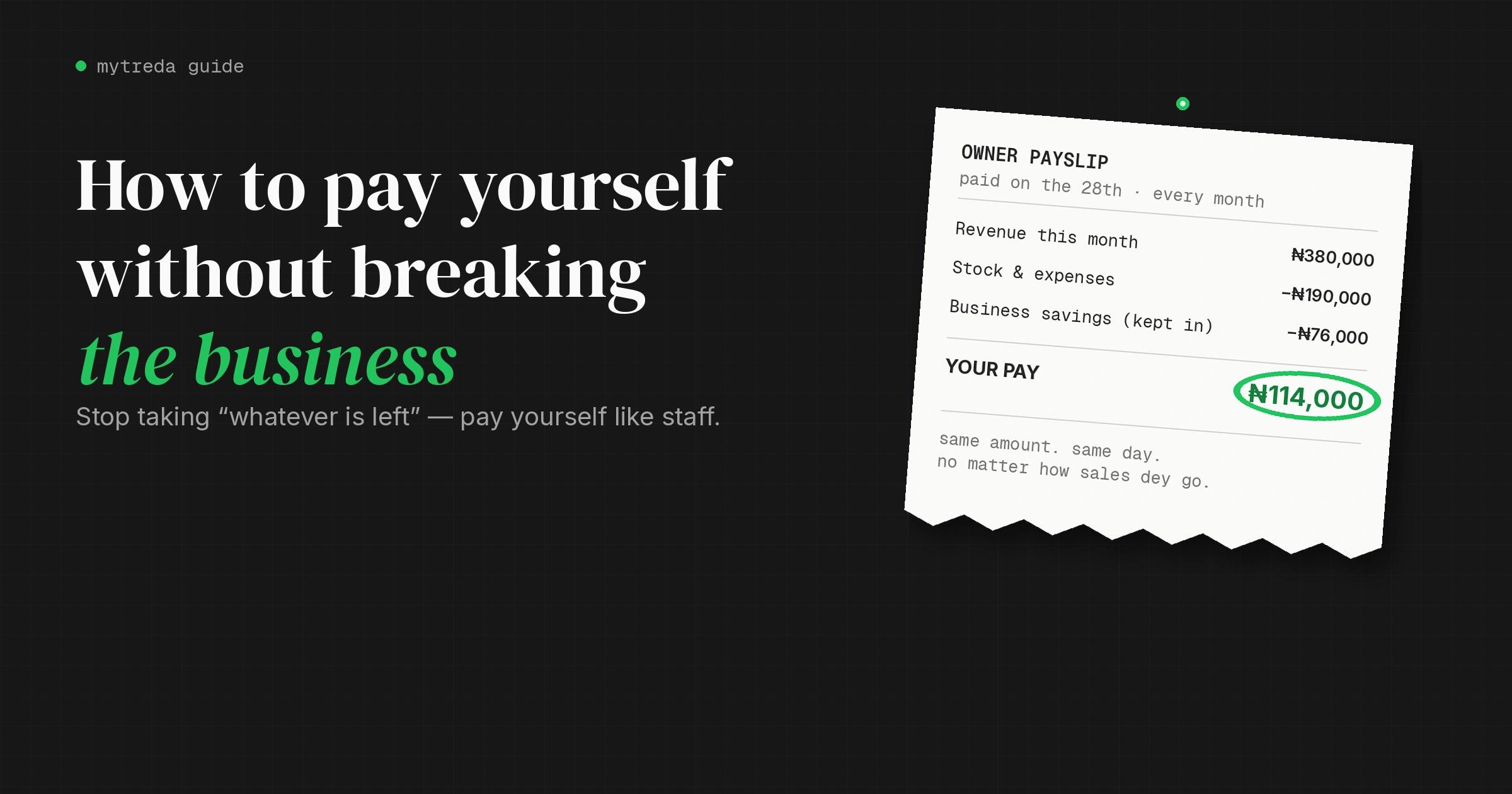
If you don't pay yourself a fixed amount yet, this sum is hard to do honestly, because you can't tell what's left for the loan from what's left for your house. I wrote about how to pay yourself from your shop, and it's worth doing before you borrow.
So the real question is not "how much do I sell?" It's "after my goods, my expenses and my own pay, what's left in an ordinary month?" That number is the ceiling on any repayment. And a repayment that uses all of it leaves no room for the month that isn't ordinary.
The 30% Test
Every trader knows months that aren't ordinary. January after Christmas. Rainy season when customers stay home. A fuel price increase that pushes up transport and makes customers spend less at the same time.
So before you borrow, ask the question BIG SAM put to his machine loan: what happens if things fall by 30%? Here is the same shop with sales down 30%:
A bad month (example figures)
| Sales | ₦840,000 |
|---|---|
| What those goods cost you | − ₦672,000 |
| Rent, pay, transport, electricity and data | − ₦125,000 |
| What you pay yourself | − ₦60,000 |
| Left over | − ₦17,000 |
Sales fell by 30%. What was left over fell from ₦55,000 to less than nothing.
That is the part that catches people. When sales drop, the cost of goods drops with them, but rent doesn't. Your sales girl still needs her pay. Your family still eats. Those costs stay where they are, so a small fall in sales becomes a big fall in what's left.
Now picture that bad month with a ₦100,000 repayment on top.
You don't have to refuse every loan that fails this test. But you should know, before you sign, where the repayment would come from in a bad month. If the honest answer is "from my stock money" or "I'll borrow again to pay it", the loan is too big for the shop, or its repayments are too fast.
Borrowed Money in Slow Stock Is the Most Dangerous Debt
A loan for stock carries a risk a loan for rent doesn't: the goods have to sell before you can repay, and the lender's calendar doesn't wait for your customers.
Say you borrow ₦500,000 and agree to repay ₦540,000 over three months, ₦180,000 a month. You use it to buy 50 cartons of a product at ₦10,000 a carton, planning to sell them at ₦12,000.
If all 50 sell in the first month, you take in ₦600,000, and the loan is comfortable.
If they sell 12 cartons a month, you take in ₦144,000 in the first month. That doesn't cover even one ₦180,000 repayment, and after three months you still have 14 cartons on the shelf. The loan is due in full, and part of it is sitting in your shop as stock.
Same loan, same product, same price. The only difference is how fast it sells, and that is the one thing a trader is most likely to guess instead of check.
So before you borrow for a product, look at how fast that product sold the last time you had it, not how busy the shop felt:
- How many did you sell last December, or last back-to-school, or whatever season you're stocking for?
- How long did the last batch take to clear?
- Did any of it expire, spoil or end up discounted?
Put borrowed money into goods you already know move fast. Try new products with your own money, in small quantities, first. If you're stocking up for a season, the stocking calendar covers when to buy ahead and when to wait.
Read What You'll Repay, Not the Interest Rate
"5% interest" sounds small. Before you agree to it, ask three questions.
5% of what, and every how long?
5% a month is not 5% a year. Over twelve months, 5% a month adds up to 60% of what you borrowed, and more if interest is charged on unpaid interest.
What is the total I will pay back, and on which dates?
Ask for one naira figure and a list of dates. Write them down. That total, and the size of each repayment, are what you test against your bad month, not the rate.
What happens if I'm late?
Late fees, extra interest, calls to your family: find out before you need to know.
With loan apps, be more careful still. Check that the lender appears on the Federal Competition and Consumer Protection Commission's list of approved digital lenders, on the FCCPC website, and be wary of any app that asks for access to your phone contacts. If a lender won't tell you the total you'll repay in naira before you accept, don't accept.
How MyTreda Handles This
MyTreda won't tell you whether to borrow. It will give you the numbers to decide with, from what you've already recorded instead of from memory.
What's left after expenses
The "Expenses & Net Profit" card on your Dashboard shows your net profit for the month: your profit on what you sold, minus the expenses you recorded. That's the number to test a repayment against, not your sales. Record rent, transport, staff pay and the rest as expenses and it stays honest. Your own pay goes under Salaries.
What you already owe
On the Debts page, add each supplier who gave you goods on credit as a debt and choose "Supplier (you owe them)", with the amount and a due date. Everything you owe suppliers sits in one list, so when you're deciding on a new loan you can see the ones you already carry.
How fast a product really sells
The Stock Movement Report, on the Reports page, shows each product's opening stock, what came in, what sold, what was adjusted and the closing stock, for any date range you pick. Pick last December and you'll see exactly how many cartons moved, instead of guessing.
What MyTreda doesn't do
MyTreda doesn't track bank loans, loan apps or ajo contributions. Keep those amounts and dates written somewhere you'll see them, and include them when you add up what you owe.
What to Do This Week
Do this even if you have no plan to borrow. The day someone offers you a loan is the wrong day to start the sum.
- Monday: list everything you owe. Suppliers, ajo, cooperative, apps, bank, family. Amount and due date for each.
- Tuesday: find last month's net profit. From your Dashboard, or by doing the ordinary-month sum above with your own figures.
- Wednesday: take off what you pay yourself. What's left is the most your shop can repay in an ordinary month.
- Thursday: run the 30% test. Cut sales by 30%, keep rent, staff and your own pay the same, and see what's left.
- Friday: check your best sellers. For anything you'd borrow to stock, look up how many sold the last time and how long the batch took to clear.
- Saturday: if you're considering a loan, get the total. One naira figure and a list of dates, tested against Thursday's bad month.
Borrow Like You Plan to Still Be Open Next Year
A loan can grow a shop. Traders borrow to buy in bulk at a better price, to stock up before a season, to take a second shop. None of that is wrong.
What goes wrong is borrowing against the best month instead of the ordinary one, and stocking with borrowed money on a feeling instead of a record. Your sales book already knows how much your shop can carry. Ask it before you ask the lender.
Ready to try MyTreda?
Join thousands of Nigerian traders managing their business better with MyTreda.
Get Started TodayWritten by
Tochukwu Nwosa
The founder of MyTreda Technologies Ltd. He grew up in an Igbo trading family, watched his brother lose money to an untracked apprentice in Onitsha Main Market, and built MyTreda so other Nigerian traders don't have to go through the same thing. He lives and works in Lagos.